January 2026 Meeting — Meshtastic Update with Tom, KE6SRO

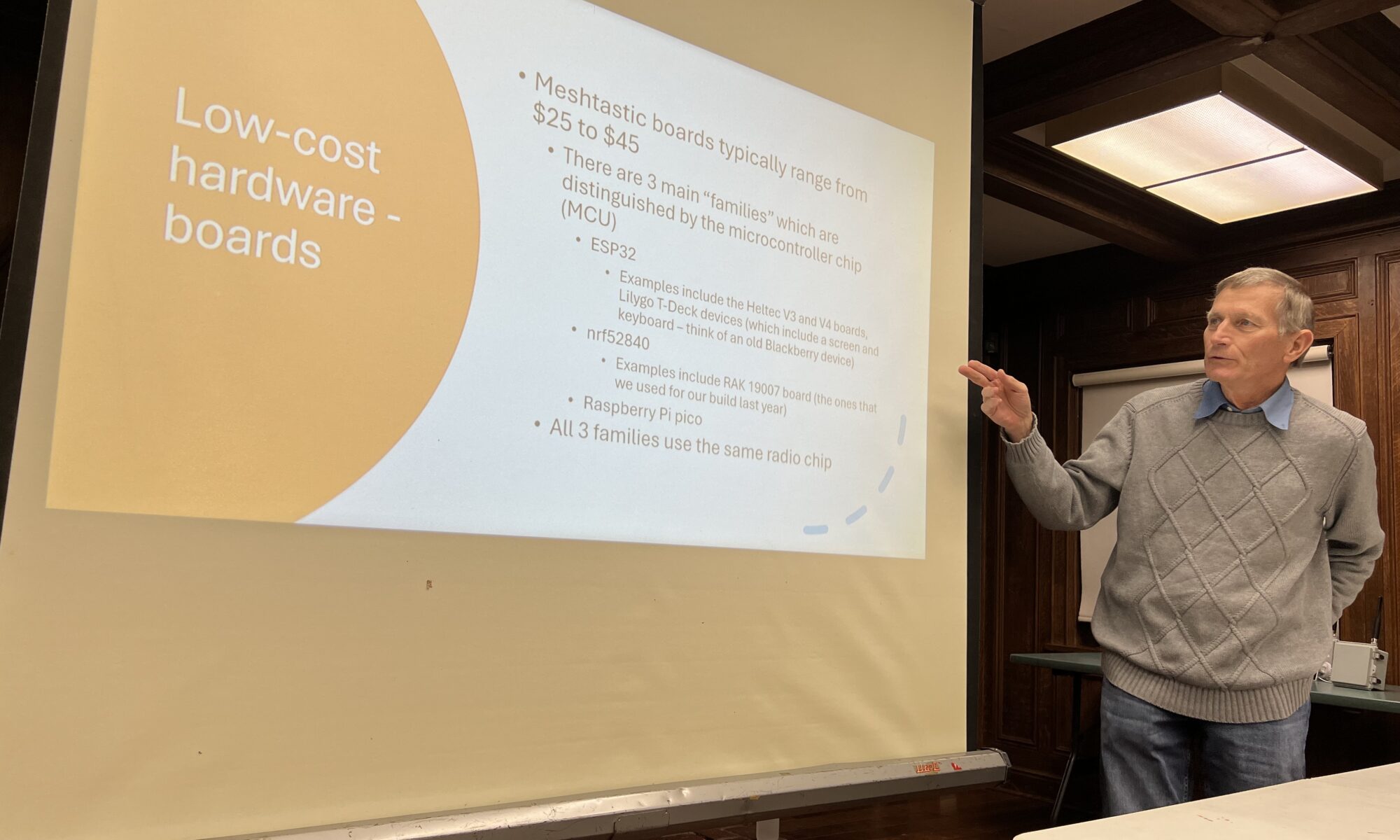
Tom, KE6SRO with a slide about Meshtastic hardware options

SPARC president Tom Bruegge, KE6SRO led our first meeting of the year and gave a presentation on how to improve the performance of our Meshtastic nodes.

Many club members who deployed Meshtastic devices last year were frustrated at their inability to connect with other SPARC nodes and the unpredictability of the local Meshtastic network. Tom explained several specific factors which influence Meshtatic’s network topography. Changing certain settings within the Meshtastic app may increase the likelihood of a good connection. But the most important factor is updating your node’s firmware to the latest version. Tom followed up his presentation with advice on the firmware update procedure:

The simplest way to do this is to go to the Meshtastic website. Once there, you can choose your device, choose the firmware version, and then flash.  If you have one of the RAK boards that we purchased as a group last year, you should choose “RAK WisBlock 4631” as your device type.  I would suggest leaving the firmware to the default of the latest stable release (which, is actually a stable beta — there never seems to be anything that they call a final release, just alpha and beta versions of the software). 

Once you’ve chosen the device and the firmware version, you can just flash the device directly from the web browser.  One caveat is that this web flasher does require that your browser be a “Chromium” based browser.  Examples are Google Chrome and Microsoft Edge browsers.  Apple’s Safari and Firefox will not work with the web flasher. 

In order to flash the device, you’ll need to connect the device to your computer using a USB cable (USB-C on the device end).  You also need to make sure that the device is in its “DFU” mode.  (I don’t know what that stands for, but basically, this is the state that the device needs to be in so that the new firmware can be uploaded.)  How this is done varies by device.  For the RAK 4631, a quick double press of the reset button after connecting the device to the computer via USB should do the trick.

Finally, it’s really important that you have a good-quality USB cable to attach the device to your computer.  I know that I tried several cables before I got one that worked well.  (Many USB cables are only useful for charging, not for data transfer.)

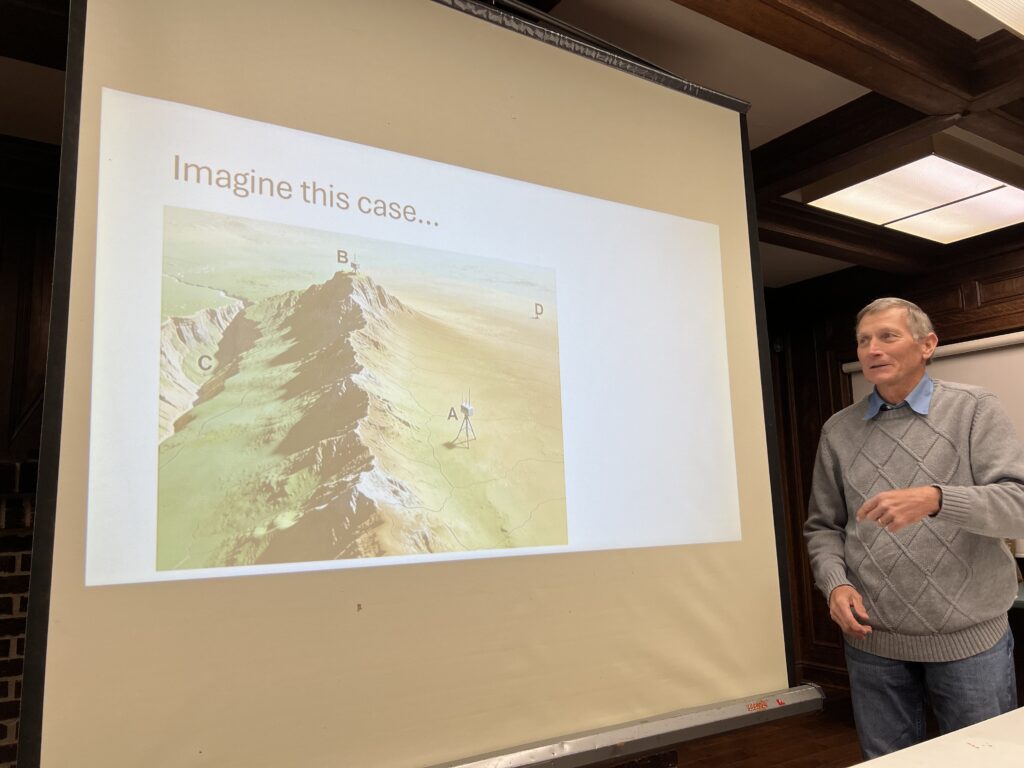
Tom, KE6SRO with a slide demonstrating how elevation affects Meshtastic connections.

Tom concluded with an overview of MeshCore, an alternative to Meshtastic that uses different algorithms and device classes. MeshCore works on much of the same hardware as Meshtastic, including the nodes we purchased as a club last year. While the MeshCore network in our area is not as robust as Meshtastic’s, it is sufficient for experimenting and comparing performance. MeshCore also uses an app and browser-based web flasher.

Tom’s full presentation is embedded below.

Modifying the Quansheng HT to Operate CW

Note: Carol, KE6SRN demonstrated her modified Quansheng HT at SPARC’s August 2025 meeting.

In preparation for the 2025 NorCal and SoCal SOTA group camping events, several ham operators thought it would be fun to make contacts on 2m CW.  This was motivated by the recent discovery that the Quansheng radios (UV-K5 or UV-K6) could be modified to support this capability.  At the time of this writing these radios sold for $28, making 2m CW both affordable and accessible to those holding even the entry level (Technician) ham operating license class.

The modification involves first installing the new IJV2.9 firmware:
Manuale Firmware UV V2.9R5
followed by the removal of a tiny, tiny resistor and jumping two components with a 1” wire. 

This hardware modification is explained in the following YouTube video:

This video refers to a “Secret Menu.” It is accessed by turning the radio off, then pressing and holding the PTT and the side button beneath it (F1) while turning the radio back on.  Set menu item 3 to CW.

After the modification, the CW signal can be sent with by pressing the PTT button, or by using the microphone input with a key.  Only a straight key signal is accepted, but a double paddle can be used by using one paddle as a straight key.  One exception was that Mark, KD7DTS demonstrated Iambic paddle mode by use of a keyer he built for $15.  (Keying is weird. You have to send a dit before every separate transmission.  That’s a Quansheng problem not the keyer. Mark said the keyer wiring was not correct also.  He’s going to make a video.  )

This modification does not disable the original features of the radio, including FM operation.

June 2025 Meeting: Field Day Plans

At our June monthly meeting, we reviewed plans for SPARC’s upcoming joint operation with the Pasadena Radio Club, JPL Amateur Radio Club, and the Caltech Amateur Radio Club for Field Day. This represents an expansion from last year’s Field Day and an attempt to recapture some of the scale from pre-Covid times. The details are:

Start: Saturday, June 28 at 11:00 a.m.
End: Sunday, June 29 at 10:59 a.m.
Location: ArtCenter College of Design, Hillside Campus, south parking lot
Enter at 1700 Lida St., Pasadena, CA 91103
What3Words location: help.rock.vouch

There will be a Get on the Air (GOTA) station operating from 1 p.m. to 5 p.m. on Saturday. Members of the public with no radio license are welcome to visit the station and get a taste of Field Day excitement for themselves.

We will operate under the special event call sign N6P, “November Six Papa,” as a class 4A station. The GOTA station will operate with SPARC’s call W6SPR, “Whiskey Six Sierra Papa Romeo.” Thanks to our Field Day coordinator Carol, KE6SRN for securing the special event call!

If you were unable to attend the meeting and would like to operate with us, please reach out through our contact form. If you are operating from home and would like to contribute your score to the aggregate club total, note that our group name will be “PRC/SPARC/JPLARC/CITARC” this year.

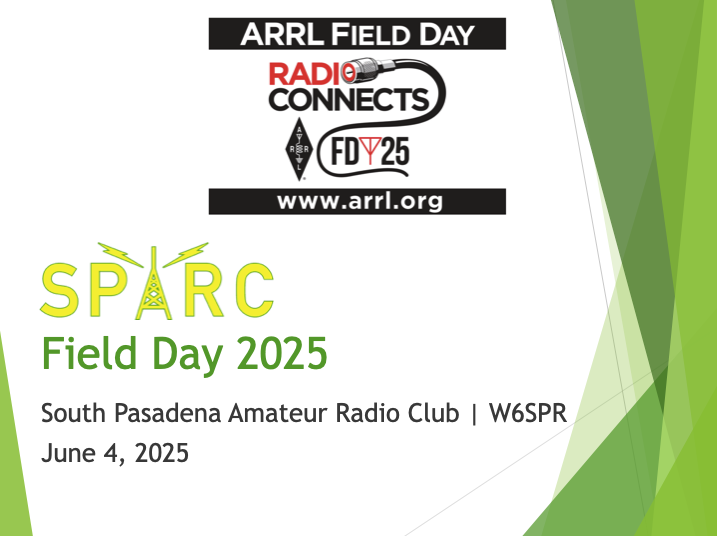
Click this link or the image below to download a copy ( 2 MB PDF) of this year’s Field Day presentation.

If you can’t be with us in person for Field Day, we hope to hear you on the air!

November 2024 Meeting: HF at Home


At our November meeting, SPARC members shared the antennas they use to get on the HF bands at home. Here are a selection of pictures and comments on each antenna.

Chameleon Emcomm II

The antenna is pointed northeast but is not very directional. It handles 200 watts on SSB, 100 watts on digital. Thanks to its 5 to 1 coil, the wire is resonant on 20, 40, 80. Using the antenna on 30 and 80 requires a tuner. The tripod was purchased on Amazon and spray-painted matte black to blend into the environment.


Comet CHA-250B vertical

The Comet is mounted on a pole attached to the garage on a hinged base so it can fold it down if conditions are windy. The antenna is self-contained, requiring no radials. It receives impressive DX like Brazil, Japan and Australia. However, it picks up a fair bit of noise too. A key advantage is its small, unobtrusive footprint.

MFJ Mobile Ham-tenna Whips

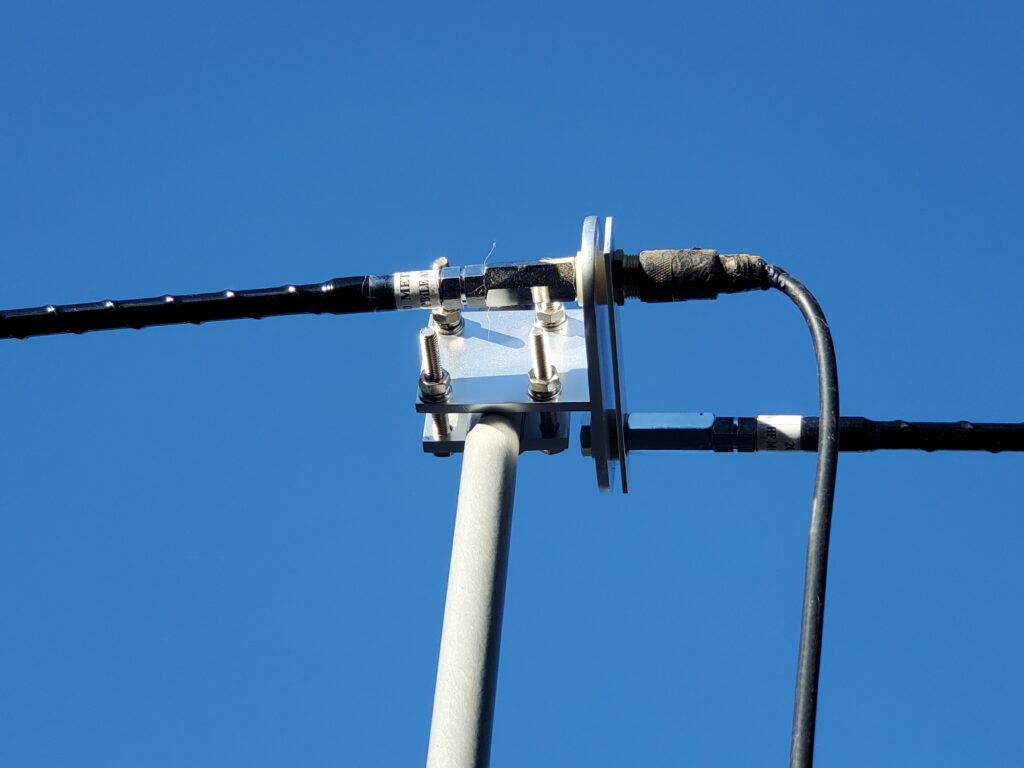
This is a pair of MFJ “HF Mobile Ham-tenna Whips” on a back-to-back bracket, forming a dipole configuration. The pairs of whips are tuned to a single band [10, 20, 40m] and do a good job. The bracket and whips are mounted on a fiberglass push-up mast with a tripod base. It provides the benefits of a dipole without requiring a support in, say, the neighbor’s tree. Tuning for a low SWR requires adjusting the whip length with an Allen wrench.


29’ random wire

In the box is a 9:1 UNUN that is meant for a “random” wire.  The antenna is designed not to be resonant on any particular ham frequency, and it requires an external tuner to provide acceptable SWR from 6 to 40 meters.  Build instructions are available in this PDF.

Although the instructions call for a random wire, it is necessary to avoid certain wire lengths so that the antenna is not accidentally resonant on any particular frequency. Here is a chart of safe wire lengths


NA4RR Hexbeam

The NA4RR Hexbeam covers 20m through 6m. The most difficult issue was getting it mounted on the mast. The second issue is aligning the antenna direction with the rotor control direction.


Cushcraft R7

This Cushcraft R7 is mounted at about 33 feet, covering the 10, 12, 15, 17, 20, 30, and 40-meter bands. The 40-meter band performs best. The 20-meter band has been somewhat limited, the 15-meter band challenging, and the 10-meter band works occasionally. Here are a few links for further reference:

Cushcraft A4S Yagi

This Yagi works on 10, 15, 20, and 40. It reaches essentially anywhere on earth, even the South Pole. The element lengths are 20 feet long, spaced 10 to 15 feet apart. It’s mounted on a Tri-Ex crank-up tower, requiring no guy wires, that nests down to 23 feet. The tower is just over 60 feet tall when fully deployed. There are rotators on both the tower and the Yagis on the chimney. 

Halloween Special Event Update

Our October 31 special event station W6H was a fun night of operating, even though our location didn’t have the best propagation. Here is a map of our contacts, and check out a few photos posted on our Instagram account.

October 2024 Meeting: AREDN and Meshtastic

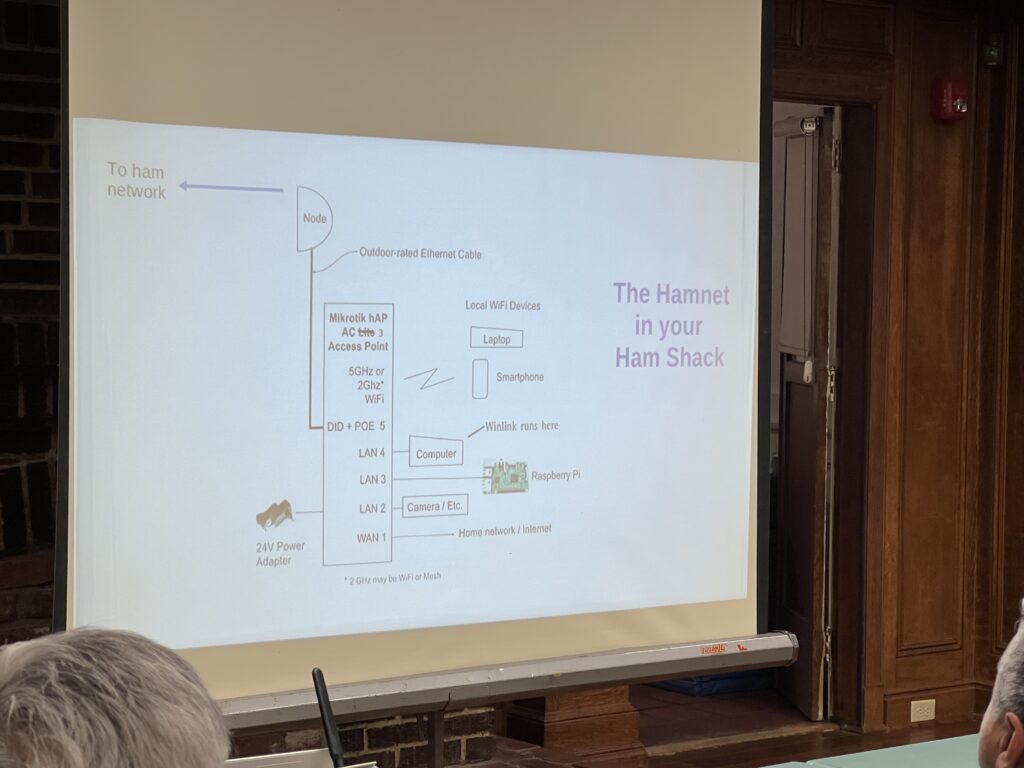
Slide explaining the components of an AREDN mesh node

At our October 2 member meeting, we discussed two popular forms of mesh networking. For those unfamiliar with it, mesh networking is essentially Wi-Fi over amateur radio or unlicensed frequencies.

First, Orv Beach, W6BI discussed the current state of AREDN, the Amateur Radio Emergency Data Network. Orv lives in Simi Valley and volunteers as an AREDN Ambassador. He helps coordinate the deployment and maintenance of AREDN in Southern California, from Paso Robles to the Mexican border and east to Las Vegas. He explained the basic requirements of setting up an AREDN node and provided examples of the many services one can run on the network. For example, live video feeds on AREDN have helped state officials track wildfire activity. The AREDN software was just updated, and Orv detailed some of its improvements.

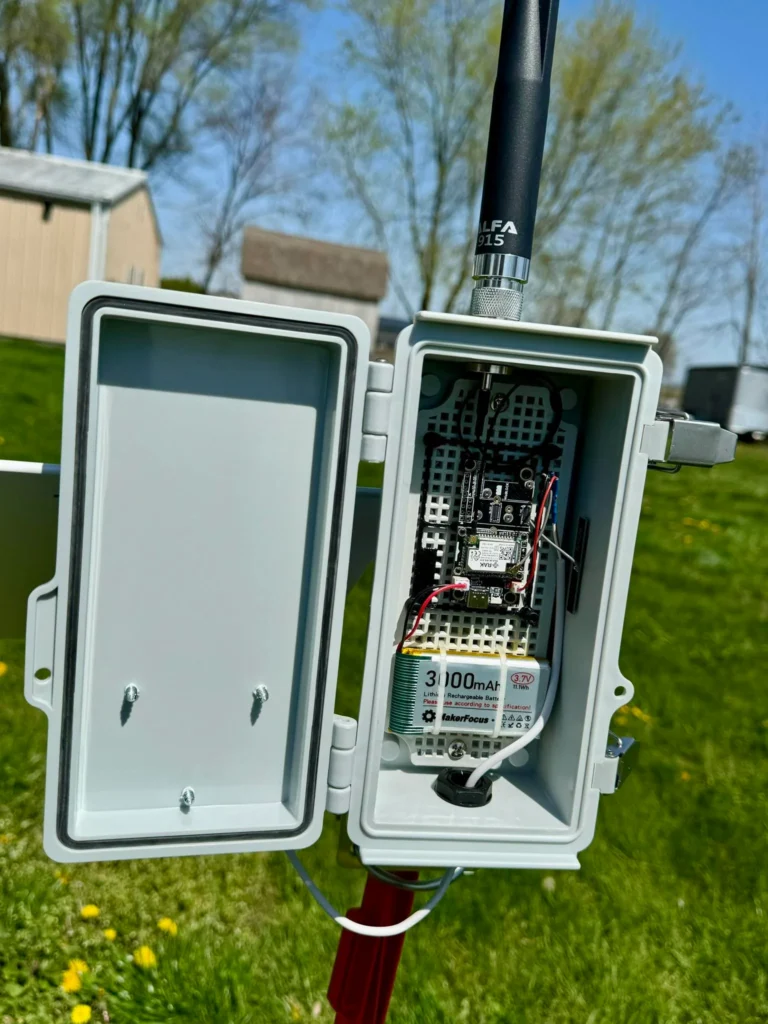
Example of an outdoor Meshtastic node

Next, SPARC member Adrian Pinedo, KN6MHG discussed his experiments with Meshtastic, a low-power form of mesh networking that doesn’t require a ham license to use. Meshtastic runs on relatively inexpensive nodes — often sold as kits — and is accessed with a phone app. During an emergency, Meshtastic can allow a neighborhood, or even a whole city, to maintain simple text communications.

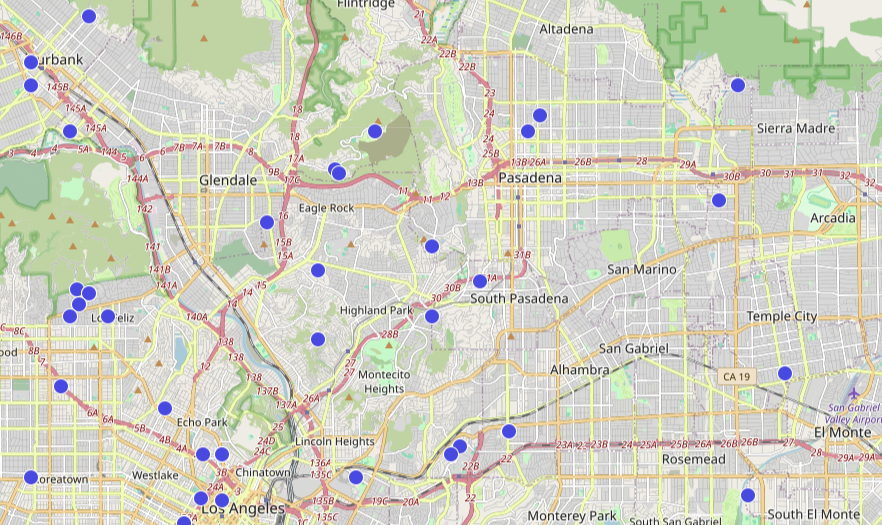
Map of Meshtastic nodes near South Pasadena

In addition to the main Meshtastic website, Adrian recommended other resources including SoCalMesh.org, Liam Cottle’s mesh map, and the Rokland store.

Based on member interest, SPARC may have a Meshtastic group build and hopefully deploy a local network. If you’re interested in participating, join our mailing list for updates.

Below is a copy of Adrian’s presentation.
September 2024 Meeting: FEMA Community Preparedness Officer Christian Erickson

At our September meeting, SPARC welcomed Christian Erickson, Community Preparedness Officer for FEMA Region IX. Christian explained that his territory covers California, Arizona, Nevada, and Hawaii, as well as the U.S. territories of the Pacific, including Samoa and Guam. In conjunction with National Preparedness Month, Christian spoke about the state of readiness in Southern California. He said that, thankfully, people in the Los Angeles area are highly motivated to anticipate and train for emergencies. Southern California was “the birthplace of CERT.” He also explained how FEMA thinks about the three stages of emergency preparedness: mitigation, near-term recovery, and long-term support.

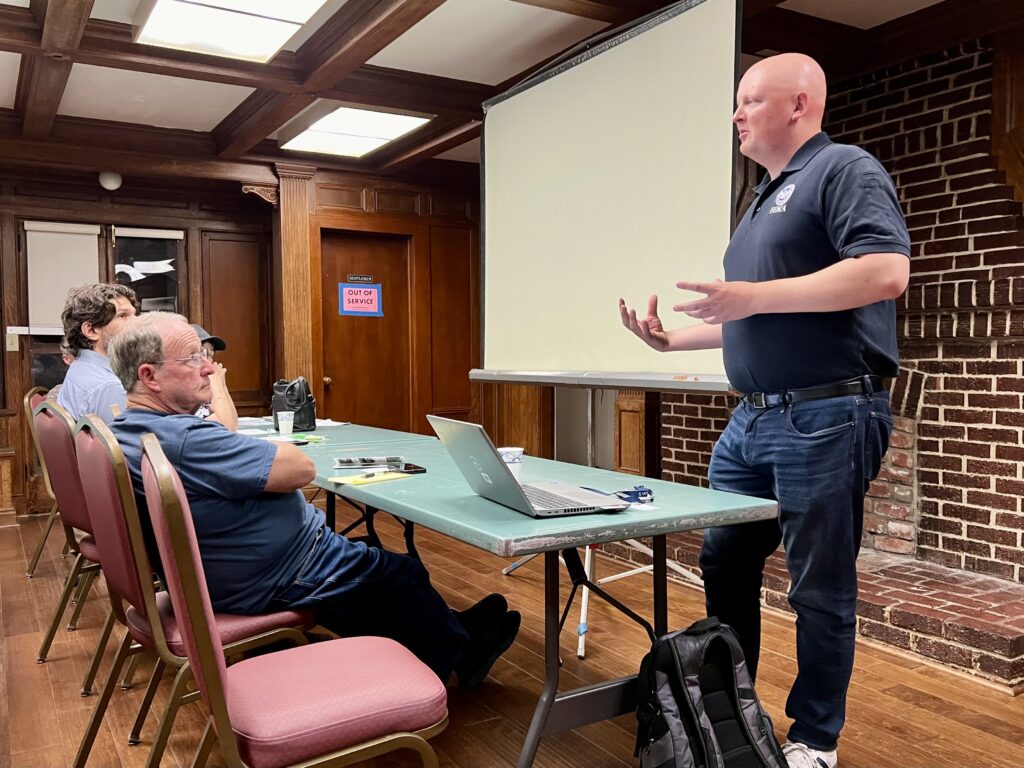
FEMA Community Preparedness Officer Christian Erickson speaking to SPARC on September 4, 2024

When asked how to encourage a community to engage in preparedness, Christian replied that one effective method is to inspire youth to participate. When young people are motivated to address preparedness, they frequently convince their parents to take the issue more seriously. Finding methods that are fun and welcoming are also key — fear mongering leads to worry but not action. One tool he is excited about is a tabletop game called Disasterville. Christian also recommended Quake Heroes, a documentary released to coincide with the thirtieth anniversary of the Northridge Earthquake.

After Christian’s remarks, John, KK6ZVQ shared “How to Build an Emergency Plan,” a step-by-step guide to personal preparedness. The presentation is embedded below. Most of the resources mentioned in the slides are available at SPARC’s dedicated preparedness page.

SPARC thanks Christian Erickson for his time and insight. And we’d like to thank all of the community members who joined us to discuss this vital topic.

August 2024 Meeting: SOTA and POTA


At our August 2024 meeting, SPARC members enjoyed presentations on SOTA (Summits on the Air) and POTA (Parks on the Air). Walter “Savi” Savinovich, W1SAV led with his talk on the joys and challenges of operating from parks. A video of Savi’s presentation is embedded below and is available on his YouTube Channel. Next, David Hodge, N6AN explained how he tackles SOTA activations and showed off photos from local peaks. David is a past president of the Pasadena Radio Club and a well-known competitive DXer. 

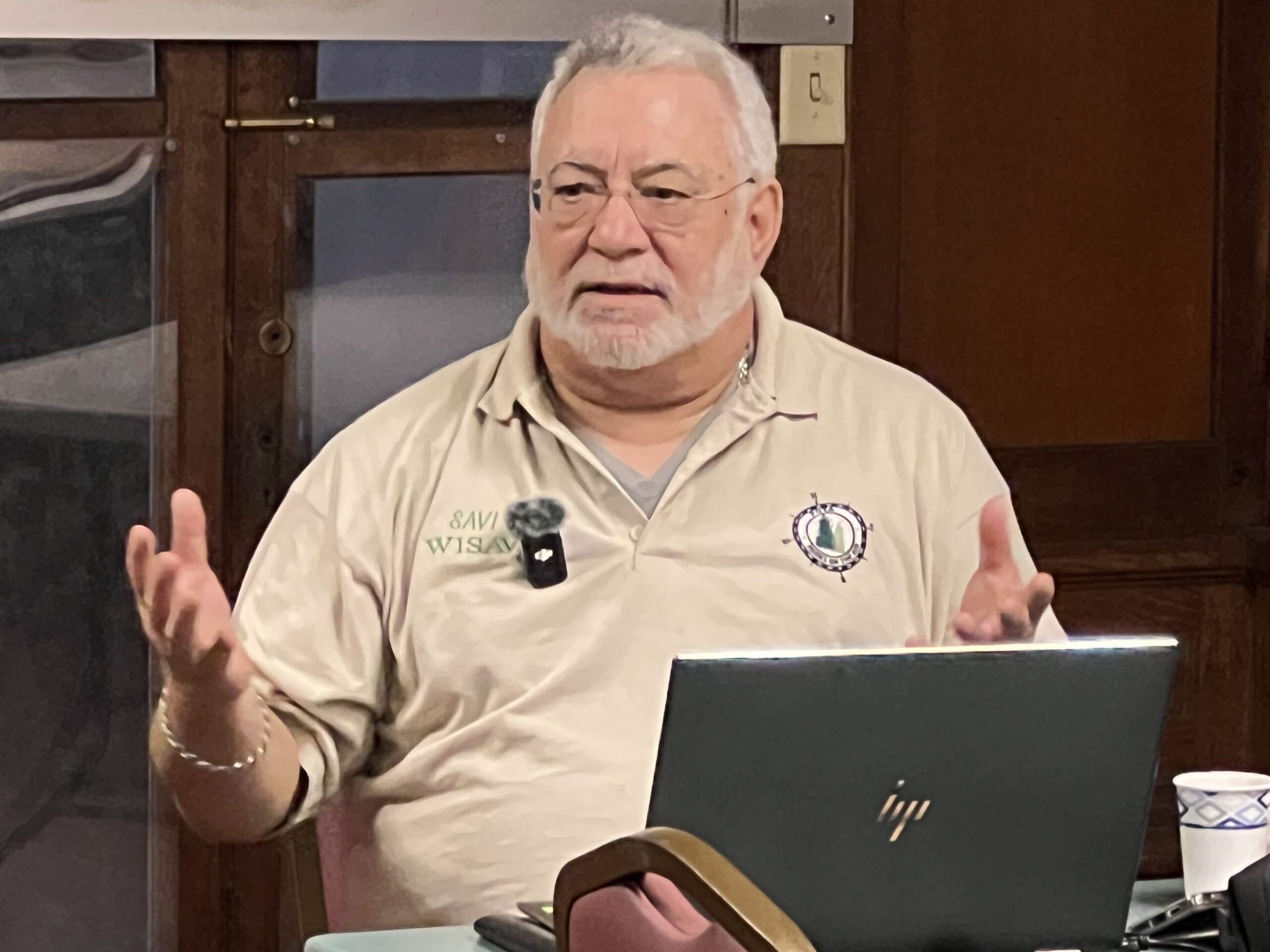
Walter Savinovich, W1SAV
David Hodge, N6AN

We concluded the evening with a door prize drawing. Two attendees went home with multi-purpose Teraoka tape donated by Carol KE6SRN. And in honor of David N6AN, our third prize was  Contact Sport, a book about the 2014 World Radiosport Team Championship, in which David participated. (There’s a picture of him on page 45.)    

On August 17, SPARC will hold its very own SOTA POTA Fest. We’ll be activating Flint Peak for SOTA and Rio de Los Angeles Park for POTA. If you’d like to participate, join our Groups.io mailing list.  

Click here to download Savi’s slides.

Links from Savi’s presentation:

Mapping Contacts | Global DX Map w/ Propagation

POTA main page | POTA spotting page | POTA scheduling page

Field equipment: Chameleon Antennas | Yaesu Radios | Elecraft Radios

Savi’s home logging program: Amateur Contact Log | Mobile logging software: HAMRS

Savi’s dashboard of Log Analytics (built with Tableau Public)

Savi’s Blog | Savi’s YouTube Channel | Email: w1sav [at] arrl [dot] net

More SOTA/POTA inspiration:

“Radio and Rides” blog by SPARC member Carol K6SRN

Article on POTA by Jenna Canillas, WW0MAN for the Rio Hondo ARC June 2022 newsletter

June 2024 Meeting: Preparing for Field Day

At our June monthly meeting, we discussed SPARC’s upcoming joint deployment with the Pasadena Radio Club for Field Day. This will be our clubs’ first in-person Field Day since 2019. SPARC has volunteered to set up a VHF/UHF station and organize its operators. The details are:

Start: Saturday, June 22 at 11:00 a.m.
End: Sunday, June 23 at 10:59 a.m.
Location: Art Center College of Design parking lot
Enter at 1700 Lida St., Pasadena, CA 91103
What3Words location: help.rock.vouch

If you were unable to attend the meeting and would like to operate with us, please reach out to us through our contact form.

Click this link or the image below to download a copy ( 1.9 MB PDF) of this year’s Field Day presentation.

If you can’t be with us in person for Field Day, we hope to hear you on the air!

May 2024 Meeting: Learning CW with Carol, KE6SRN

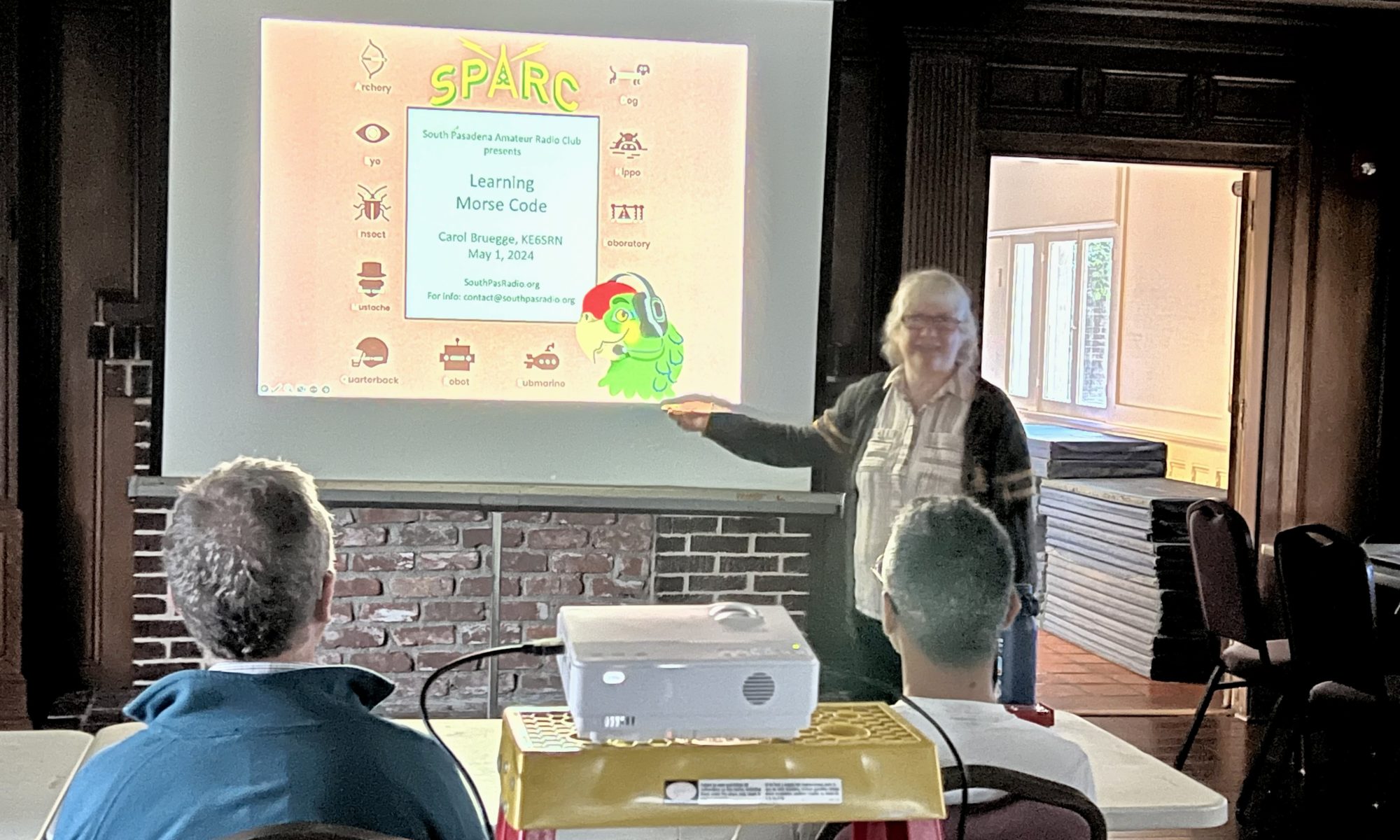
At our May 2024 meeting, SPARC member Carol Bruegge, KE6SRN gave an overview of proper Morse code usage and shared tips for how to become proficient. (Apologies for the blurry photo above.) Fun fact: What we refer to as “Morse code” is more accurately called “Gerke code” because it was standardized by a German telegraph pioneer named Fredriche Gerke. Carol covered several topics including efficient communication and free learning tools. Below are links to the tools that Carol recommended.

Click here to download all of Carol’s slides (1.7 MB PDF).

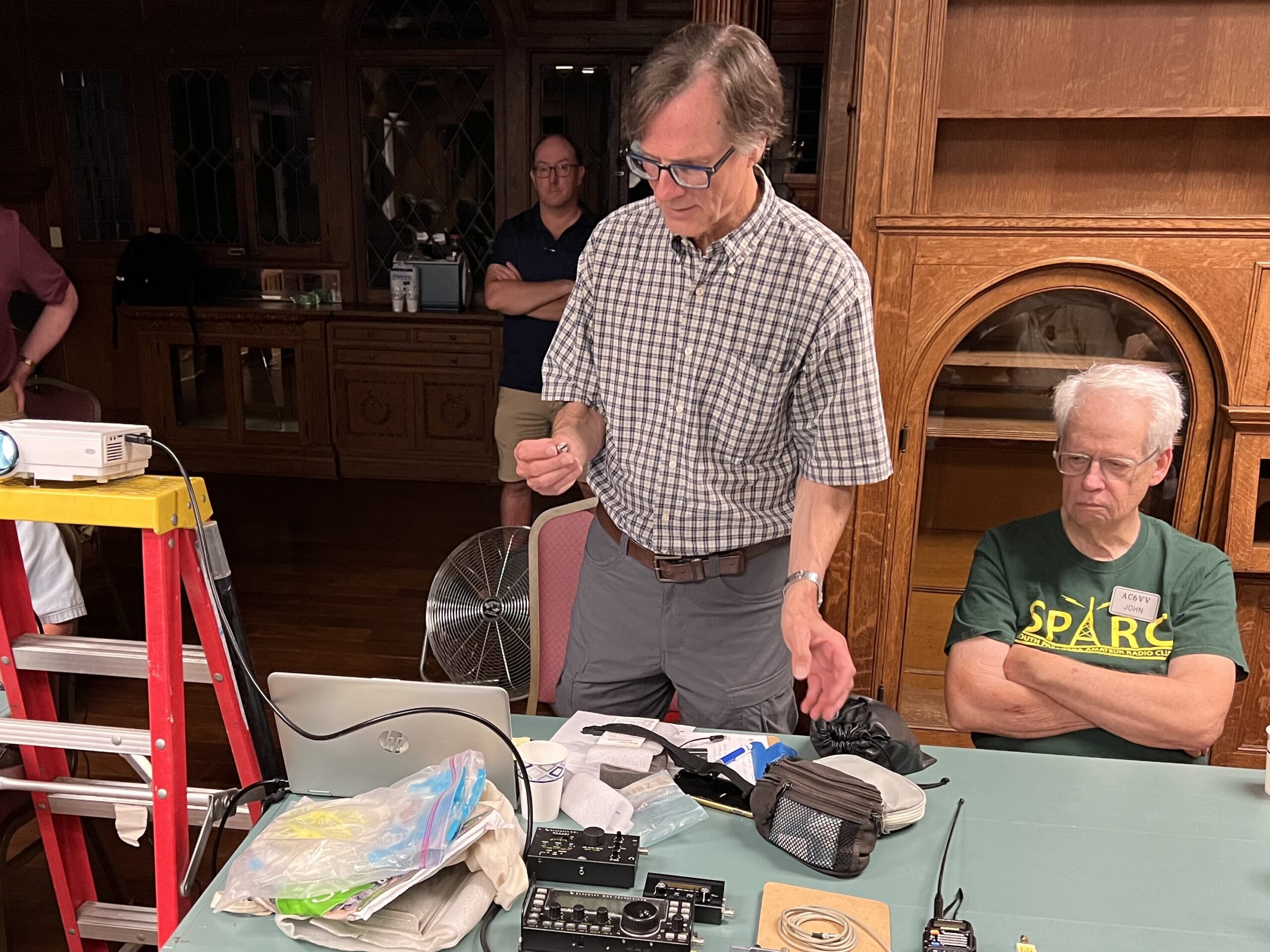
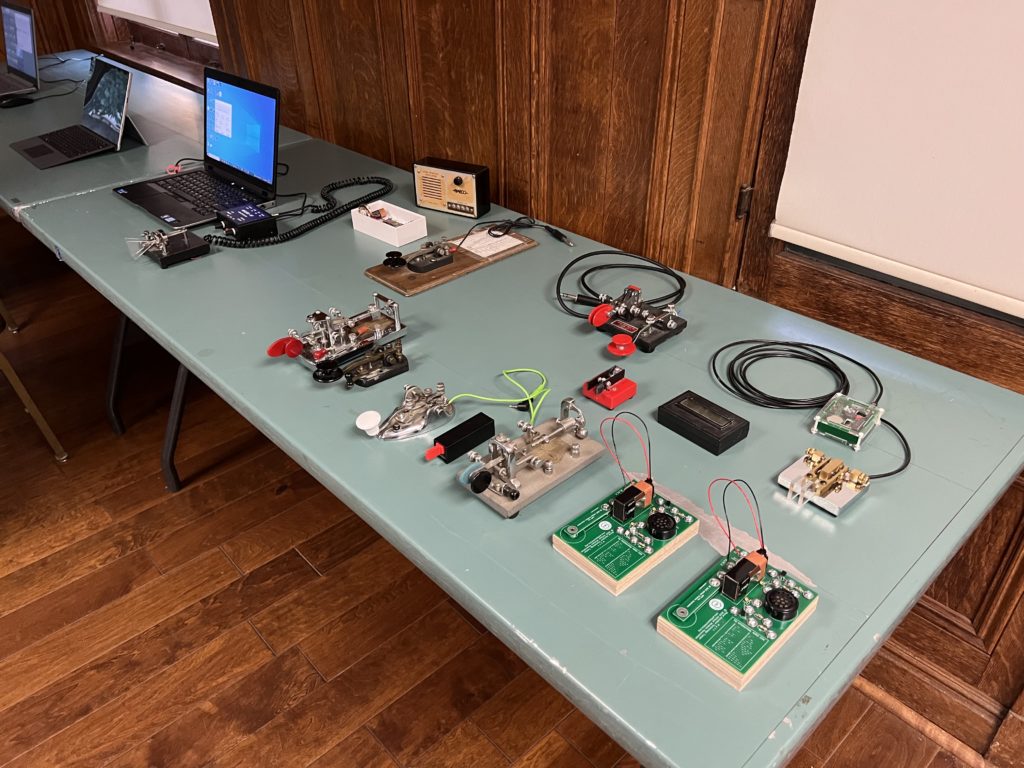
After Carol’s presentation, we had a show and tell session with paddles, straight keys, and “bugs” from SPARC members’ collections.

To the left of the paddles were laptops loaded with RufzXP, Morse Runner, and Iambic Master. Attendees could compare the programs and see which ones might be worth trying at home.

At 9:13 p.m. the ham radio satellite SO-50 passed overhead, and Rick Besocke, KI6ZKM led the group in a contact demonstration. This was an opportunity to see a satellite contact in action, inspired by our February meeting on the topic.

Rick, KI6ZKM contacts SO-50

Next month, it’s time to talk Field Day! Join us on June 5 at 7:30 p.m. in the Eddie Park House.

73,
John Aboud, KK6ZVQ

April 2024 Meeting: State of the Hobby with Diana Feinberg, AI6DF

At our April member meeting, SPARC welcomed ARRL LAX Section Manager Diana Feinberg, AI6DF. Diana has served the local ham community as section manager since 2016 and in numerous other capacities before that.  She is currently president of the Palos Verdes Amateur Radio Club, and she was formerly president of the 220 Spectrum Management Association of Southern California. She has chaired the Los Angeles Area Council of Amateur Radio Clubs, served as the chair of the HAMCON hamfest, and has been active in the Los Angeles County Disaster Communication Service.

Diana opened by discussing what is new with the ARRL both nationally and locally. Topics included:

  • How to know when the digital editions of ARRL magazines are available.
  • The fight to protect radio spectrum from high-speed trading systems.
  • ARRL membership numbers in LA County. 
  • A program that helps members locate sources of RFI (hint: check your dimmer switches first). 
  • Patterns of volunteering.

The second part of her presentation was titled “Surprises in Amateur Radio.”  It covered the aspects that make our hobby unique, including the constant improvement of its equipment and development of new modes such as the M17 standard.

As a gesture of our thanks, we presented Diana with a bag of Li’l Sparky’s Blend whole beans (actually the Lost Parrot Blend from Jones Coffee Roasters).

UPCOMING EVENTS

ARRL SSB Rookie Roundup, 4/21

For the purposes of the event, a Rookie is defined has having been first licensed in the current calendar year or the previous three calendar years, regardless of license class. You can also be a Rookie if you haven’t made any contest contacts on the contest mode (in this case, SSB).

May Meeting, 5/1

We’ll be discussing CW and Morse code. Do you have an interesting Morse key, bug, or paddle? Bring it in for a show and tell.