At our June meeting, SPARC members and guests discussed our preparations for Field Day 2026. Carol, KE6SRN gave a presentation about our station plan, operating objectives, and the opportunity for volunteers. The presentation slides are embedded at the bottom of this post.
Our special guest speaker was David Hodge, N6AN. David previously spoke to SPARC about his homebrew antennas for SOTA activations. As one of our most dedicated Field Day operators, David spoke about his background in radio and his evolution as a world-renowned contester. Here is a brief summary of what he shared:
David became interested in amateur radio when his convalescing brother was loaned a Hallicrafters S-38 receiver to pass the time. David showed more interest in the radio than his brother did, and consequently studied for and passed a Novice license exam in 1969, including a 5 WPM Morse code test. He upgraded to General class 18 months later (13 wpm). Traffic handling introduced him to contesters and higher speed telegraphy. Soon he was operating several contests every year. David has also participated from a number of countries on five continents. Extra class was reached in 1977 and the call AA6RX chosen. He obtained his current call sign, N6AN, in 2001, much shorter than previous calls XE1/AA6RX or WB6KJI.
There are many types of contests. The CQ World Wide DX contests are 48 hours in duration. All operators contact each other around the globe. The goal is to make as many contacts as possible in as many countries and CQ zones (there are 40) during the contest period. One class of entry is called multi-multi. A team of operators spends the 48 hours making contacts on the six bands, 160-10 meters, for as long as the bands are open, often simultaneously.
A good operator is smooth, fast, and efficient. The ability to copy even very weak signals through QRM and QRN is an important skill.
Likewise, operators in our upcoming Field Day should strive to be efficient. Start by asking “Is this frequency in use?” as a courtesy. Then, begin asking for contacts. There is little need to say “CQ,” but rather just “N6P, November Six Papa, Field Day.” You might say “Again, Again” if their call or exchange is not heard. Omit pleasantries such as “Please copy,” or “Good luck in the contest,” and treat this as message handling exchanges such as might be used in an emergency. Contesting helps train efficient operators, so come give Field Day a try.
Below is a guide prepared by Jim Marr, AA6QI that elaborates on best practices for the Field Day exchange.
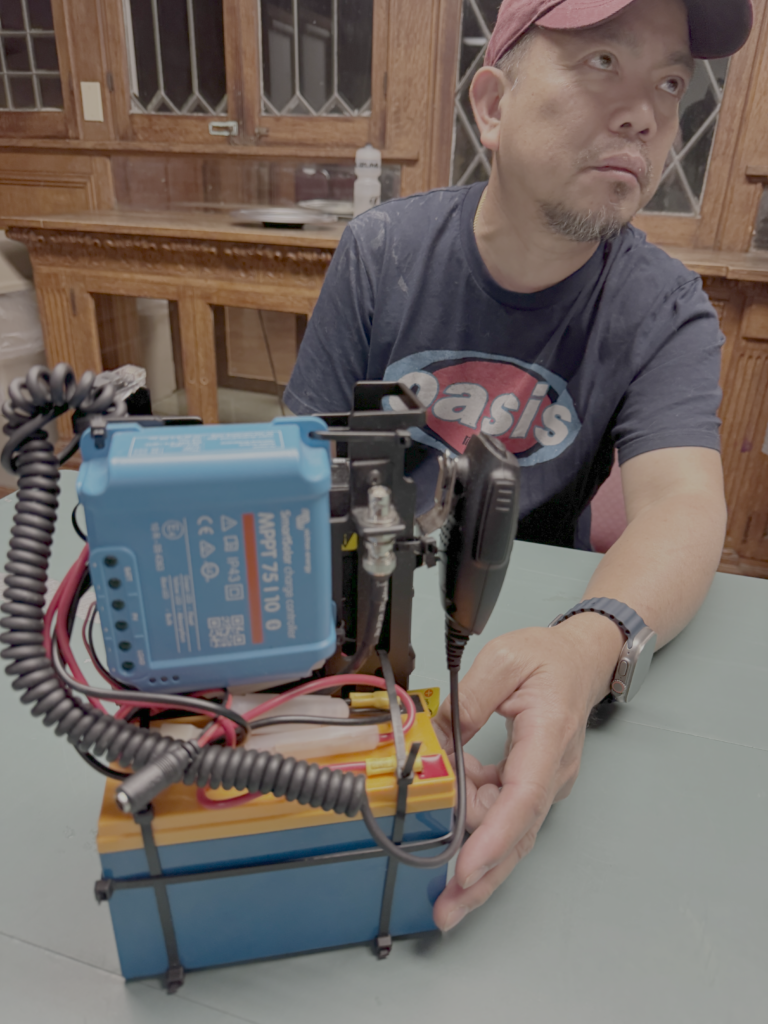
After David’s talk, Efren Batayola, KN6YYN, shared his impressive mobile radio setup which includes both a battery and solar controller.
In lieu of a traditional meeting in July, our tradition is to march in the South Pasadena Festival of Balloons parade on July 4th. Join us on Saturday, July 4th at 10 a.m. by the South Pasadena library if you would like to participate.
Field Day 2026 Presentation