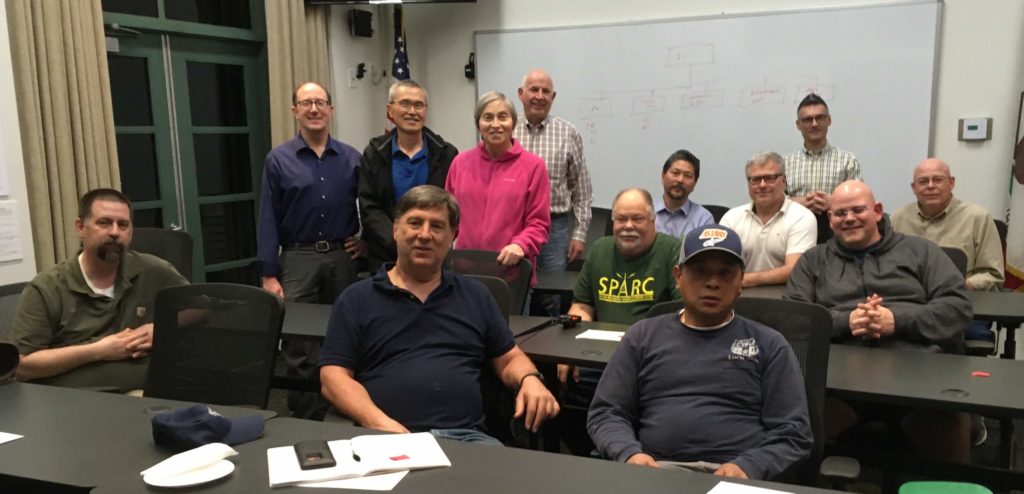
The following message comes from our friend Jim Marr AA6QI:
The family of a recently-deceased ham in eastern Altadena needs to have his tower removed by the end of October. If nobody wants the tower, it will likely end up as scrap metal.
The tower is a Telex/Hy-Gain HG-54HD three-section, crank-up, tilt-over 54 ft tower (21 ft nested). This is a heavy duty tower that supports 16 sq ft of antenna at 60 mph winds fully extended.
The in-ground base is still available from HRO or DX Engineering.
I believe that I have another ham who is willing to help take the tower down and transport it locally.
There are also two CDE Ham-2 rotators and controllers that are in a box (not on the tower).
There are also a number of antennas lying on the ground and lying on the roof of the house, antennas that I don’t recognize, that are also destined for the scrap dealer unless someone wants to rescue them.
If you are interested in these items, use our Contact Us page, and your message will be passed along to Jim.
Our September 2020 meeting featured a presentation by Marty Woll N6VI about how to build a home station. For those who weren’t able to attend, below is a version of Marty’s presentation recorded in May 2020.
Each September, SPARC encourages our community to get ready for emergencies in conjunction with National Preparedness Month. We’ve compiled many our our favorite guides, tips and resources on our Preparing for Emergencies page.
There’s no one “right way” to prepare, but the weekly themes promoted by FEMA can provide some structure. The below text is taken from FEMA’s Ready.gov.
Talk to your friends and family about how you will communicate before, during, and after a disaster. Make sure to update your plan based on the Centers for Disease Control recommendations due to the coronavirus.
Gather supplies that will last for several days after a disaster for everyone living in your home. Don’t forget to consider the unique needs each person or pet may have in case you have to evacuate quickly. Update your kits and supplies based on recommendations by the Centers for Disease Control.
Limit the impacts that disasters have on you and your family. Know the risk of disasters in your area and check your insurance coverage. Learn how to make your home stronger in the face of storms and other common hazards and act fast if you receive a local warning or alert.
Talk to your kids about preparing for emergencies and what to do in case you are separated. Reassure them by providing information about how they can get involved.
If you have a resource you’d like to share, contact us and we’ll consider adding it to our page.
Once you’ve spent September getting ready, you can test your new plans by participating in October’s annual Great Shakeout.
As this year has made abundantly clear, major disruptions to daily life can strike with little warning. Putting in time and effort now will help you manage risks later.
Dear SPARC members and friends, The South Pasadena Amateur Radio Club is holding a fundraiser from now until September 15 for maintenance and repair of the TELCO repeater. The TELCO repeater is a valuable amateur radio resource that serves the greater San Gabriel Valley and beyond. We are regular users of the repeater and benefit from its continued availability. The SPARC board has pledged to match the first $100 donated by club members. Please consider a small donation as an investment in our radio community. Please use this PayPal link or click the button below to make a contribution before September 15.
Support the TELCO Repeater
Thank you,
Rick Besocke, KI6ZKM President, South Pasadena Amateur Radio Club
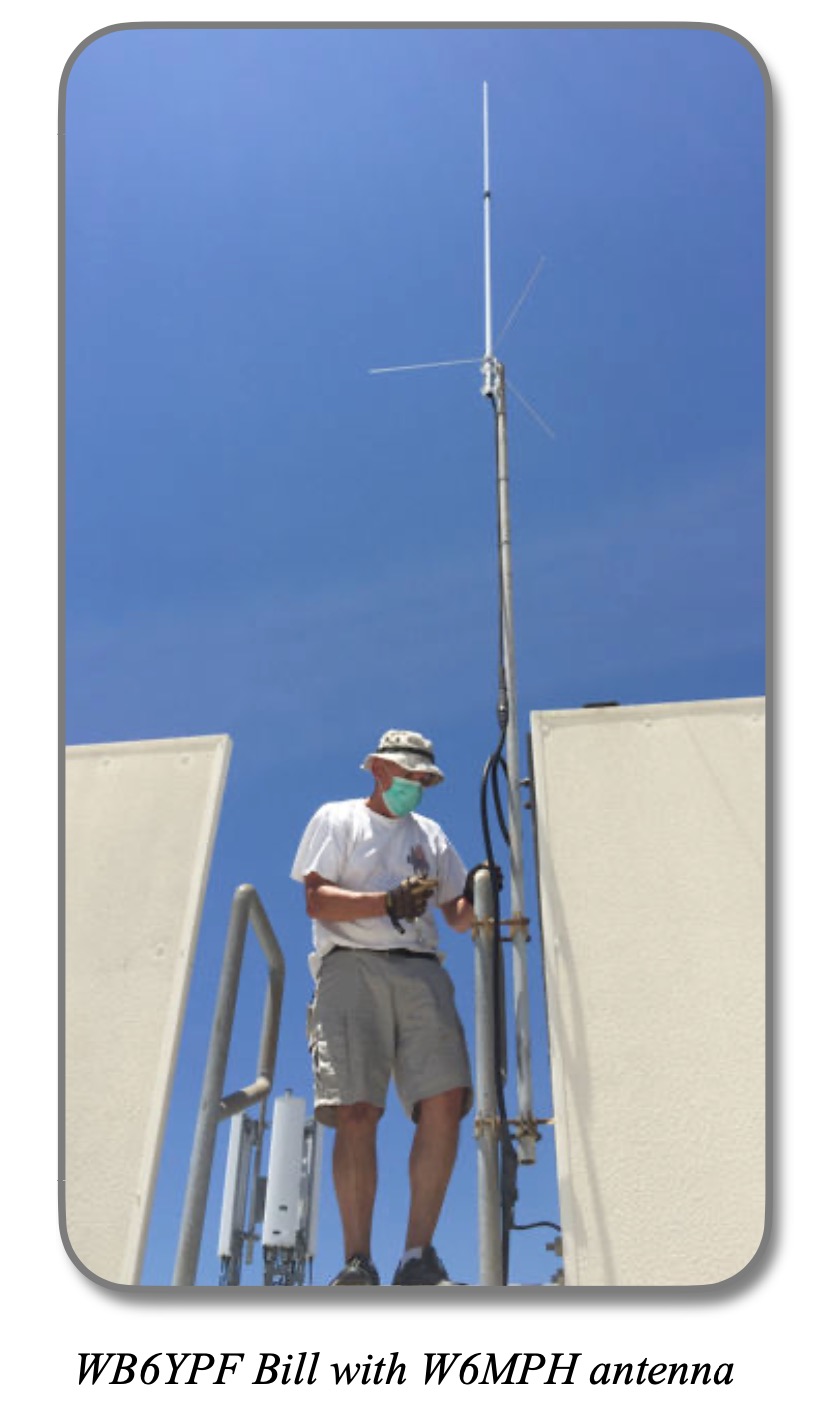
Photo of Bill Westphal WB6YPF with the TELCO Repeater antenna courtesy of Pasadena Radio Club
SPARC’s monthly meeting was held on August 5 via Zoom and featured a presentation by Jeff Liter, W2JCL entitled “The Case for Winlink.” Everyone in attendance was familiar with the basics of Winlink, so Jeff took time to cover some lesser-known features. One such feature is a catalog request, which can return information like a propagation report or weather forecast. The below video from San Diego ARES illustrates how to perform a catalog request.
Jeff also discussed how to send an SMS text message via Winlink. You can send a short email that will appear as a text message if you know your contact’s phone number and their carrier’s email-to-text address. This article from Lifehacker lists the email-to-text addresses of most major phone carriers.
Click the title page below to download Jeff’s presentation as a PDF.
Another great resource is this recent video hosted by Oliver Dully, K6OLI who is the coordinator of our local ARES (Amateur Radio Emergency Service) section, LAX Northeast. Oliver explains how ARES uses Winlink for emergency communications:
Here’s another video introduction as described in the July ARRL ARES newsletter. On June 6, 2020, Phil Sherrod, W4PHS, a Winlink developer, gave an excellent presentation on Winlink and how to use it. A Zoom audience of five hundred saw the Winlink presentation.
Finally, there has been a lot of excitement in the Winlink user community over a recent addition to the program: a way to submit data directly to the U.S. Geological Survey’s “Did You Feel It?” system. Again quoting the ARES newsletter…
On July 9, the ARES/Section Emergency Coordinators … hosted an excellent Zoom presentation on the radio amateur’s role in the United States Geological Survey (USGS) Did You Feel It (DYFI) reporting system. The speaker was Oliver Dully, K6OLI, who captured the audience of some 67 coordinators across the country with his galvanizing presentation.
Jeff W2JCL will discuss the development and use of the “Did You Feel It?” form in more detail at an upcoming SPARC meeting.
SPARC held its first-ever online monthly meeting on June 3, 2020. Until further notice, monthly meetings will be held via online conference systems like Zoom and Google Meet.
Our topic was how to prepare for Field Day 2020. If you haven’t already, mark your calendar for June 27 and 28.
Social-distancing measures prevent us from joining our friends from other local clubs for a joint Field Day operation as in years past. But Field Day can still be an exciting and rewarding opportunity to get on the air. The ARRL has made a rule change for 2020 that will let individual operators “associate” with a club and have their individual scores printed together in QST magazine. The scores will not be totaled; it’s merely a show of club spirit. (Note that if you choose this option, you should associate with “South Pasadena Amateur Radio Club” as opposed to “SPARC” because there are probably dozens of clubs with that acroynm across the country. There’s even another SPARC in South Pas!)
Below is a presentation from the meeting with more detail. As the presentation states, reading it is no substitute for reading the full Field Day rules published by the ARRL. If you have any questions, don’t hesitate to email contest@southpasradio.org for help. We’re eager to have as many members as possible participate. Hope to hear you on the air!
The SPARC VHF/UHF Spring Sprint had operators making contacts on the 144, 220, and 440 MHz bands using both FM and SSB. Seven logs were submitted before the deadline, and the top three results are as follows:
In lieu of our May monthly meeting, SPARC will hold its first-ever contest, a VHF and Up Sprint.
When: Wednesday, May 6, 2020 from 1930 to 2000 PDT.
The goal of this informal contest is for participants to make as many VHF/UHF simplex contacts as possible in thirty minutes. All modes and VHF/UHF bands are allowed, but please be sure to follow band plans, use established simplex frequencies, and listen before transmitting. A few recognized southern California FM simplex frequencies are: 145.600, 146.520, 146.550, 223.500, and 446.000. Spotting and coordinating with others is permitted and encouraged. No prizes will be awarded, but the top scores will be recognized and posted to SouthPasRadio.org .
Rules:
The contest will be held on Wednesday, May 6, 2020 from 1930 to 2000 PDT.
The contest is open to any licensed amateur radio operator.
Only amateur frequencies from 144 MHz and up are allowed.
All modes are allowed, but contacts using repeaters or satellites are not permitted.
The exchange is call sign and signal report (RST).
Participants will keep a log of contacts.
Participants will email only the number of contacts made to contest@southpasradio.org by no later than 2030 PDT. Operators with top scores may be asked to submit logs for confirmation.
Scores will be announced by 2100 PDT via email.
Hope to hear you on the air on May 6.
Rick Besocke, KI6ZKM President, South Pasadena Amateur Radio Club
Due to the COVID-19 outbreak, SPARC is temporarily suspending monthly in-person meetings. This is part of a community-based effort to slow the spread of the coronavirus. Please note that our regular meeting location, the Emergency Operations Center at the South Pasadena Fire Department, will not be accessible to the public.
Effective Monday, March 16, all city facilities will be temporarily closed to members of the public except for public meetings of the City Council, the Cultural Heritage Commission, Planning Commission and Design Review Board, which will continue to meet to ensure the approval of projects move forward as required by law.
City of South Pasadena
We will continue to hold our weekly on-air nets on Wednesday nights at 7:30 pm. We will announce any additional club activities (on-air or online) via email and this website.
Oliver Dully, K6OLI, District Emergency Coordinator for ARES LAX Northeast, suggests the following activities for radio operators looking to sharpen their skills while “social distancing”:
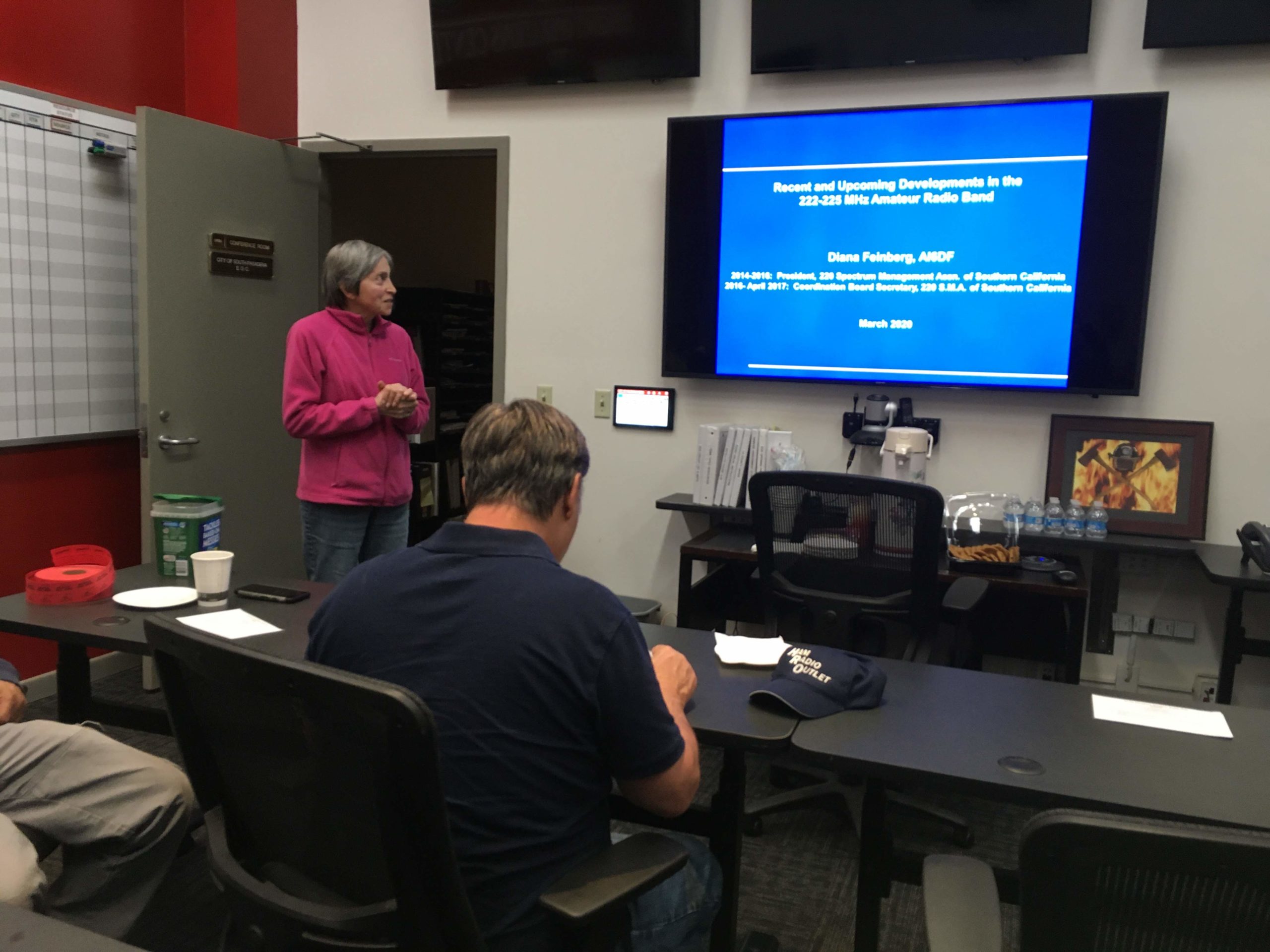
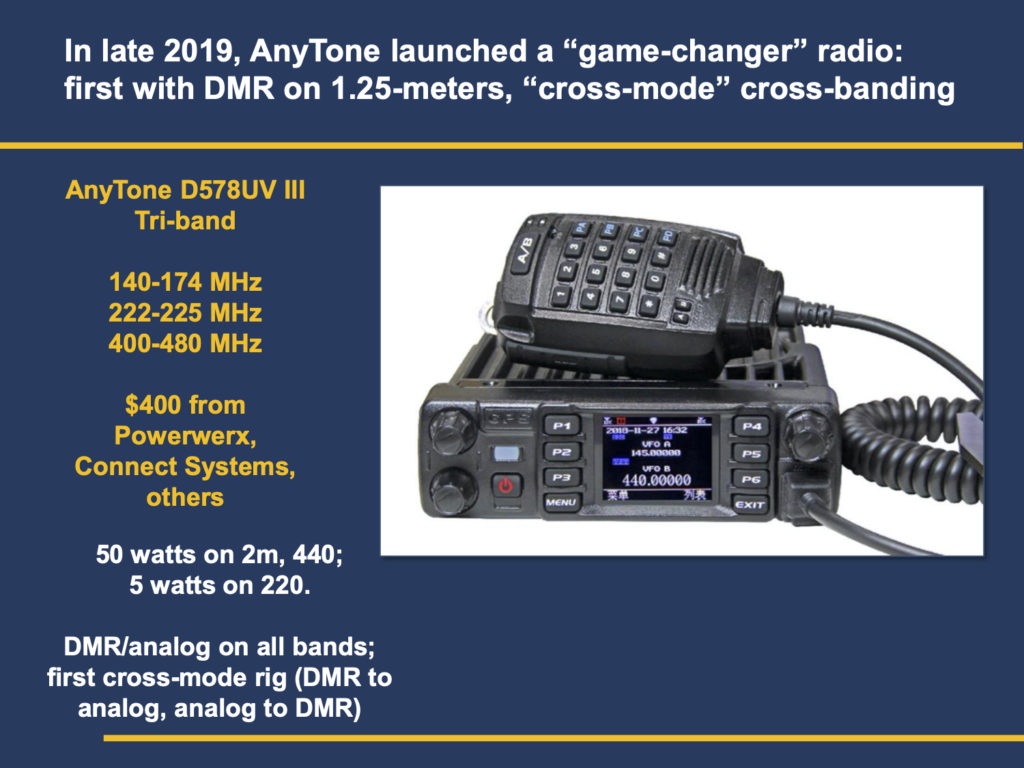
SPARC welcomed ARRL LAX Section Manager Diana Feinberg AI6DF to our monthly meeting on March 4. Diana spoke about recent leadership changes at ARRL headquarters and gave a presentation about the state of “220,” a lesser-used VHF band. Our amateur privleges on the band are between 222 MHz and 225 MHz, but we refer to the band colloquially as 220.